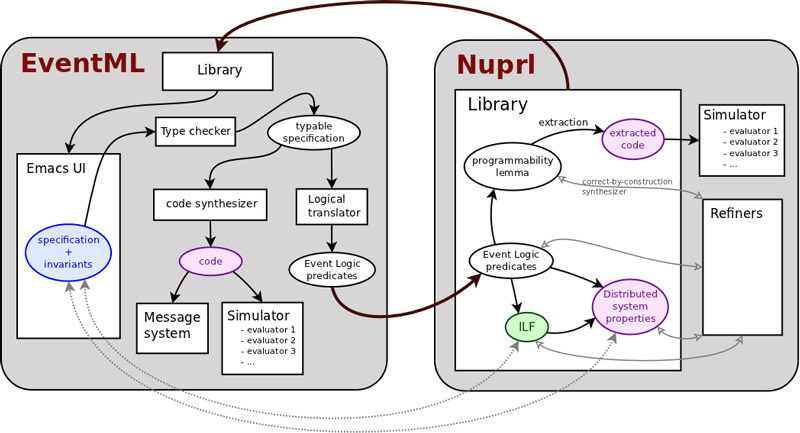
EventML is a functional programming language in the ML family, closely related to Classic ML. It is also a language for coding distributed protocols (such as Paxos Ren11]) using high level combinators from the Logic of Events (or Event Logic), hence the name “EventML”. more about specifications »
EventML was also created to work in cooperation with an interactive theorem prover and to be a key component of a Logical Programming Environment (LPE). more about theorem prover interface »
This tutorial also includes multiple example protocols, including:
- ping pong
- 2/3 consensus
- Paxos
To download EventML and for additional documentation see: http://www.nuprl.org/software
About this document
This is a web projection of An Introduction to Event ML [PDF] created Feb. 2012 using tex4ht.